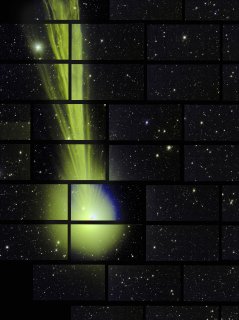
 The 570-megapixel Dark Energy Camera in Chile captured this photo of Comet Lovejoy on Dec. 27, 2014.
The world's most powerful digital camera caught an amazing glimpse of Comet Lovejoy when it passed in front of the sensitive field of view.
The "accidental observation" of Comet Lovejoy on Dec. 27 shows the comet's nucleus and coma splayed across several frames the camera took. At the time, Lovejoy was 51 million miles (82 million kilometers) from Earth. Ordinarily, the Dark Energy Camera looks at far more distant objects; it can image things up to eight billion miles (12.8 billion kilometers) away.
"Our favorite [memory] all was the accidental observation of Comet Lovejoy, " wrote the blog Dark Energy Detectives (a blog of the Dark Energy Survey) of the sighting. "It reminds us that before we can look out beyond our galaxy to the far reaches of the universe, we need to watch out for celestial objects that are much closer to home."
 The camera is 570 megapixels and is designed to look for lights from galaxies and stars far away from Earth. Its field of view is about 2.2 degrees, equivalent to an area of sky 20 times the size of the moon seen from Earth.
Comets are debris left over after the solar system formed 4.6 billion years ago. Let's see what you know about these ancient and elusive celestial wanderers.
0 of 10 questions complete
Comet Quiz: Test Your Cosmic Knowledge
Comets are debris left over after the solar system formed 4.6 billion years ago. Let's see what you know about these ancient and elusive celestial wanderers.
0 of questions complete
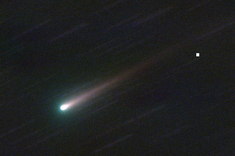
The comet, officially called Comet Lovejoy C/2014 Q2, is named after the amateur astronomer in Australia who spotted it. Terry Lovejoy has found five comets to date; all comets are automatically named after the person or entity who first discovers it. This latest one was discovered in August 2014.Lovejoy appears to glow green in telescope views of amateur astronomers, who have captured numerous images and video of the comet since its discovery.
Follow Elizabeth Howell @howellspace, or Space.com @Spacedotcom. Follow us @Spacedotcom, Facebook or Google+
INTERESTING VIDEO

INTERESTING FACTS
- The Dark Energy Space Telescope (Destiny), was a planned project by NASA and DOE, designed to perform precision measurements of the universe to provide an understanding of dark energy. The space observatory will derive the expansion of the universe by measuring up...
- The Dark Energy Survey (DES) is a survey that aims to probe the dynamics of the expansion of the universe and the growth of large scale structure. The collaboration is composed of research institutes and universities from United States, Brazil, England, Germany and...
-
 In astronomy and cosmology, dark fluid is an alternative theory to both dark matter and dark energy and attempts to explain both phenomena in a single framework.
Dark fluid proposes that dark matter and dark energy are not separate physical phenomena as previously...

What is dark matter and dark energy in space?
It is a hypothetical form of energy. -- That was invented to account for the fact that the rate of expansion of the universe appears to be increasing.
There is as yet no confirmation that dark energy actually exists.
And because there is no evidence for its existence, it throws doubt on the issue of the expansion.
Share this Post
latest posts
-
 Dark energy in Space October 16, 2026
-
 Newton Calculation October 7, 2026
-
 Gravitational attraction formula September 28, 2026
-
 Dark Matters September 19, 2026
-
 Earths gravitational pull September 10, 2026
-
 Nikola Tesla Anti gravity September 1, 2026
-
 Earths gravitational field August 23, 2026
-
 What is the Dark energy? August 14, 2026
-
 Gravitational attraction between Earth and Moon August 5, 2026